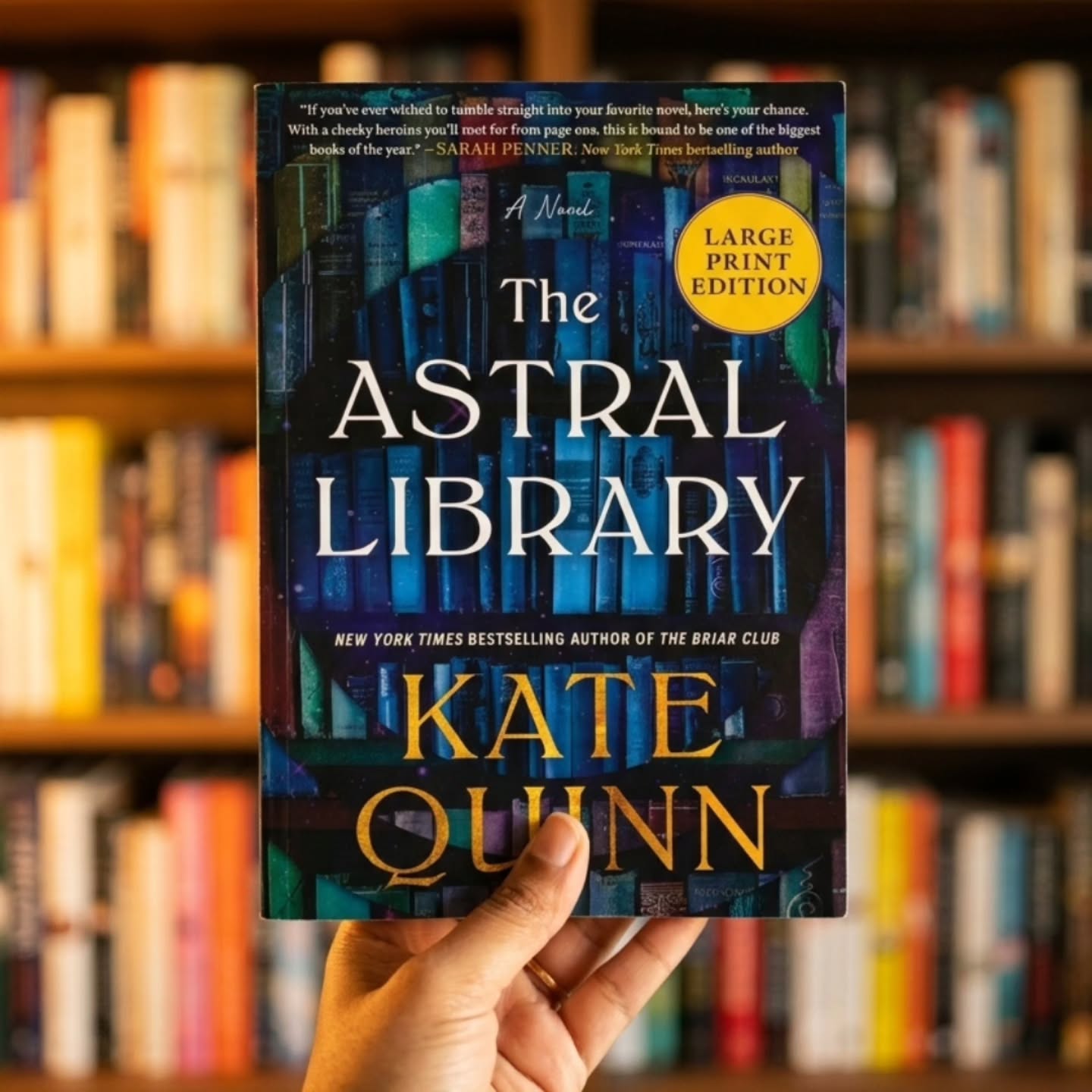
The Astral Library
-------------------------------------
Author: Kate Quinn
Published: 2024
Genre: Fantasy
-------------------------------------
IBC Editorial Rating: 3.5/5
This book is handpicked by the IBC Editorial Team. If you are an author, publisher, or reader and would like to have a book reviewed by IBC, you may reach us at editorial@indianbookclub.com — we’ll be happy to review it.
-------------------------------------
Editorial Review:
For some people, libraries are not simply places — they are the first safe place. Alexandria Watson has spent her life in the foster care system, learning that people leave and circumstances shift. Still, a book, opened at the right moment, holds its world intact regardless of what is falling apart around you. When a hidden door in the Boston Public Library leads her to something far beyond what she imagined — a secret repository where the lost and desperate can step directly into the pages of their favourite stories — it feels less like magic and more like a homecoming. The Astral Library is a love letter to reading, refuge, and the quietly radical idea that stories do not merely reflect life — sometimes, for the people who need them most, they are the thing that makes life survivable.
-------------------------------------
Book Summary:
Alix Watson is surviving, which is different from living, and she knows the difference. Three jobs, no college, no family to speak of — her childhood in foster care left her with a clear-eyed understanding of what the world offers people in her position, and a single, unshakeable consolation: books. Every night, she retreats to the reading room of the Boston Public Library, losing herself in fantasy worlds with the commitment of someone who has very good reasons to want to be elsewhere. Then she finds the door. Behind it is the Librarian — ageless, sharp-tongued, and entirely disinclined to be charming about the extraordinary thing she has spent her existence protecting. The Astral Library is a place where people who have run out of options in the real world can step into the books they love and begin again. It is, in every sense, the place Alix has been looking for without knowing it existed. Before she can settle into this new reality, something threatens it. A shadowy enemy has set their sights on the Library and everyone connected to it, and Alix — newly arrived, still finding her footing — finds herself at the centre of a chase that moves through some of the most beloved landscapes in literary history. Regency drawing rooms, Victorian London fog, the glittering excess of Long Island in the twenties: Quinn deploys each setting with evident affection and enough specificity to satisfy readers who know these worlds well and intrigue those who are encountering them for the first time. Alongside Alix is a dashing costume-shop owner whose role in the Library's world is more layered than it first appears, and the Librarian herself — whose acerbic guardianship conceals a history as complex as the institution she protects. The found family that forms around Alix gives the novel its warmest emotional texture, and the mystery of who is threatening the Library and why provides narrative momentum that carries the adventure sequences without overwhelming the quieter pleasures of the world Quinn has built.
-------------------------------------
Key Takeaways:
:Books as refuge and lifeline": The novel makes explicit what many readers have always felt privately — that literature is not entertainment so much as survival infrastructure. For Alix, and for everyone the Astral Library has ever sheltered, stories are not an escape from life but an extension of the will to keep living it. "The devaluation of libraries and the people who defend them": Quinn weaves into the adventure a pointed commentary on what happens when institutions that serve the vulnerable are dismissed, defunded, or actively targeted. The enemy threatening the Library is not simply a plot device — they represent a real and recognisable hostility toward the spaces that democratise knowledge and imagination. "Found family as the family you choose": Alix arrives at the Library with no one. What she accumulates — the Librarian's gruff mentorship, the community of those the Library has sheltered — is rendered with the particular warmth of a writer who understands that chosen bonds carry their own profound validity. "Identity and belonging for those the system failed": Alix's foster care background is not backstory — it is the lens through which the entire novel operates. Her hunger for a place that will not disappear, for people who will not leave, gives the fantasy premise a genuine emotional anchor.
-------------------------------------
Iconic Lines, Scenes & Characters:
The Librarian is the novel's most vivid creation — ageless, acerbic, and carrying the specific authority of someone who has seen everything and chosen, repeatedly, to keep protecting it anyway. Her mentorship of Alix is the relationship the novel builds most carefully, and its development is where the story earns its real emotional rewards. The literary settings are where Quinn's evident love of fiction becomes most infectious. Moving through Jane Austen's drawing rooms, Holmes's London, and Gatsby's parties with a chase plot threading through them is a premise that delivers on its promise — each world is rendered with enough texture to feel genuinely inhabited rather than merely referenced. The found family dynamic accumulates quietly and lands hard. Alix does not announce that she has finally found her people. She simply stops being alone, incrementally, and the novel trusts readers to feel the significance of that without underlining it. The novel's argument for libraries is made not through polemic but through the story itself — through the specific people the Astral Library has sheltered and what it would mean to lose that shelter. It is advocacy rendered as narrative, which is always the more persuasive form.
-------------------------------------
Who Should Read This:
The Astral Library is for the readers who have always suspected that their love of books was something more than a hobby, something closer to a necessity. If you have ever felt that a library saved you in some specific and not entirely metaphorical sense, this novel will feel like it was written with you in mind. Readers who love literary Easter eggs, intertextual adventures, and the pleasure of recognising beloved fictional worlds rendered from the inside will find the novel consistently rewarding. The tone is whimsical without being weightless, and the found family at its centre gives it an emotional substance that elevates it beyond pure escapism. A gentle note: the romance subplot is present but lightly sketched, and readers coming primarily for the love story may find it underdeveloped. The novel's real heart is the relationship between Alix and the Library — between a young woman who never had a home and the most extraordinary home imaginable. For readers who need that story, it delivers with genuine warmth.
************************
IBC Editorial Note:
This review is part of the Indian Book Club’s editorial initiative to spotlight books that inspire, inform, and leave a lasting impact on readers. Every title featured is carefully handpicked and reviewed by the IBC Editorial Team to maintain quality, authenticity, and literary value. If you are an author, publisher, or reader and would like to submit a book for review, we’d be delighted to hear from you. Please write to us at: editorial@indianbookclub.com Our team personally evaluates each submission, and selected books are featured as official IBC Editorial Reviews on our platform.