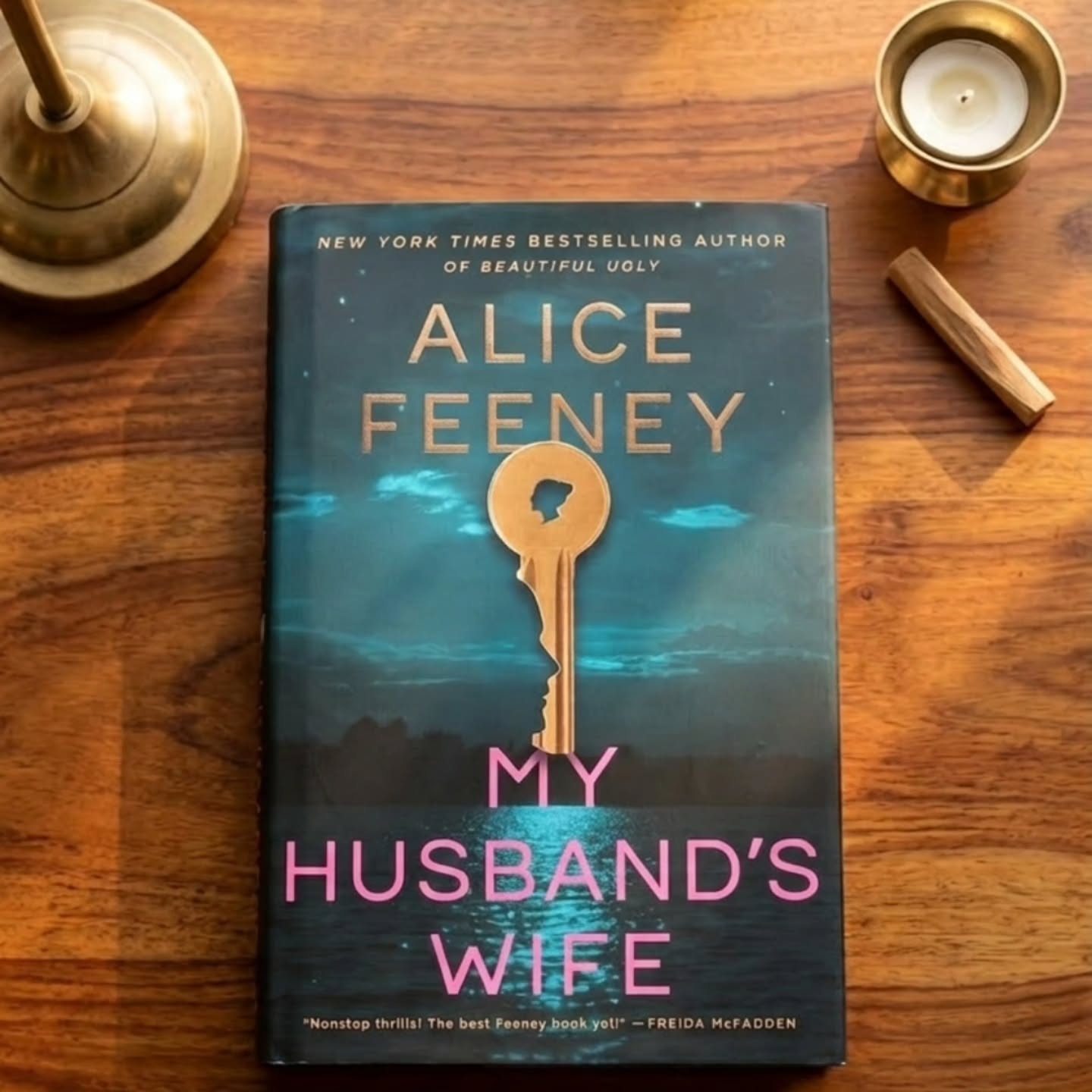
My Husband's Wife
-------------------------------------
Author: Alice Feeney
Published: 2026
Genre: Other Genre
-------------------------------------
IBC Editorial Rating: 4.5/5
This book is handpicked by the IBC Editorial Team. If you are an author, publisher, or reader and would like to have a book reviewed by IBC, you may reach us at editorial@indianbookclub.com — we’ll be happy to review it.
-------------------------------------
Editorial Review:
You come home one day and your key no longer fits the lock. A woman who looks like you answers the door. And your husband says she is his wife. From this single, vertigo-inducing opening, Alice Feeney constructs a thriller that refuses to give you solid ground for long enough to catch your breath. My Husband's Wife moves between two women — Eden, an artist whose life has been inexplicably replaced, and Birdy, a reclusive Londoner who inherits a seaside house along with secrets she never asked for — weaving their stories together with the deliberate, unsettling precision of someone who knows exactly where the trap door is and has no intention of telling you. A marriage thriller built on the understanding that the most frightening mysteries are the ones closest to home.
-------------------------------------
Book Summary:
Eden Fox has worked toward this moment for years. Her first exhibition is imminent, her life is finally taking shape, and the house she has recently made her home — Spyglass, an old and enchanting property in the seaside village of Hope Falls — feels like the physical embodiment of everything she has built. Then she returns from a morning run to find that none of it is hers anymore. The key does not work. The woman who answers the door shares her face. And her husband, standing in the hallway of her own home, looks at the stranger and calls her his wife. Six months earlier, a woman named Birdy received life-altering news in London. Reclusive, quietly adrift, she is still absorbing the implications of a devastating diagnosis when she learns she has inherited Spyglass from a grandmother she barely knew. She travels to Hope Falls expecting a house. What she finds is the beginning of something she cannot yet name — a thread, once pulled, that begins to unravel with alarming speed. Feeney alternates between these two perspectives with a structural confidence that keeps the reader perpetually off-balance. Each chapter advances the story and deepens the confusion simultaneously, not in a way that frustrates, but in the way of a puzzle that keeps revealing itself to be larger than you thought. The timeline shifts, the loyalties shift, and every character the novel invites you to trust gives you, eventually, a reason to reconsider. At its heart, the novel is concerned with identity — how it is constructed, how it can be stolen, and how the people closest to us can become the least legible. The marriage at the centre is not simply a plot device. It is the novel's primary site of investigation: what does it mean to know the person you have chosen truly, and what happens when that certainty is surgically removed? The seaside setting of Hope Falls carries a Gothic undertow that suits the material precisely — beautiful on the surface, uneasy beneath it. And Spyglass itself, the house at the centre of both women's stories, accumulates a presence that makes it feel less like a location and more like a participant.
-------------------------------------
Key Takeaways:
"Identity as something that can be taken": The novel's central horror is not supernatural — it is the possibility that the life you have built can be dismantled and inhabited by someone else. Feeney takes that fear seriously and constructs her plot around it with genuine psychological intelligence. "Trust and its architecture": Every relationship in the novel is built on an assumption that proves, at some point, to be worth questioning. The novel is a sustained examination of how we extend trust, how we maintain it, and what it costs us when it turns out to have been misplaced. "Secrets and the weight of old wrongs": Birdy's storyline carries a quieter, more melancholy register than Eden's — she is not just uncovering mysteries but reckoning with histories that predate her. The novel suggests that secrets do not simply hide. They accumulate, and eventually they act. "Mortality and urgency": Birdy's diagnosis gives her storyline a particular emotional texture. Faced with a predicted end, she finds herself compelled to act differently — to pursue truth rather than comfort, to right wrongs she might otherwise have left alone. It is a thread that gives the thriller its unexpected emotional depth.
-------------------------------------
Iconic Lines, Scenes & Characters:
The opening is the novel's most audacious achievement. The image of returning home to find yourself replaced is so viscerally unsettling that it functions almost as a physical sensation — and Feeney wastes no time before committing to it completely. Spyglass earns its name. There is something watchful about the house as Feeney renders it — a sense that it has observed more than it has been told and holds its knowledge carefully. It is one of the more effective uses of setting as atmosphere in recent thriller fiction. The clinic that predicts death is the novel's strangest and most provocative element — surreal enough to unsettle, grounded enough to sustain. What Birdy does with that information, and how it connects to everything else, is where the novel's most daring plotting lives. The dual female perspectives are the novel's structural backbone. Eden and Birdy are distinct enough to prevent confusion and connected enough to generate the slow, dawning recognition that their stories are not simply parallel — they are entangled in ways that neither of them understands until Feeney decides it is time to show them.
-------------------------------------
Who Should Read This:
My Husband's Wife is for readers who want their thrillers to leave them genuinely uncertain — not just about whodunit, but about what is even happening and who can be believed at any given moment. If you read psychological suspense for the pleasure of having the ground shift beneath you repeatedly and without warning, this delivers that experience with considerable skill. Feeney's writing has a particular quality that resists easy description — she generates confusion that compels rather than frustrates, maintaining narrative grip even at the moments of greatest disorientation. Readers who appreciate multi-perspective thrillers where the structure itself is part of the mystery will find this one especially satisfying. A note of realistic expectation: some elements push past the plausible into something more heightened, and readers who require strict realism in their psychological thrillers may occasionally feel the tension between Feeney's ambition and the boundaries of the believable. For everyone else — for readers who are willing to surrender to a story and trust that the chaos has a design — this is exactly the kind of thriller that reminds you why you read them.
************************
IBC Editorial Note:
This review is part of the Indian Book Club’s editorial initiative to spotlight books that inspire, inform, and leave a lasting impact on readers. Every title featured is carefully handpicked and reviewed by the IBC Editorial Team to maintain quality, authenticity, and literary value. If you are an author, publisher, or reader and would like to submit a book for review, we’d be delighted to hear from you. Please write to us at: editorial@indianbookclub.com Our team personally evaluates each submission, and selected books are featured as official IBC Editorial Reviews on our platform.