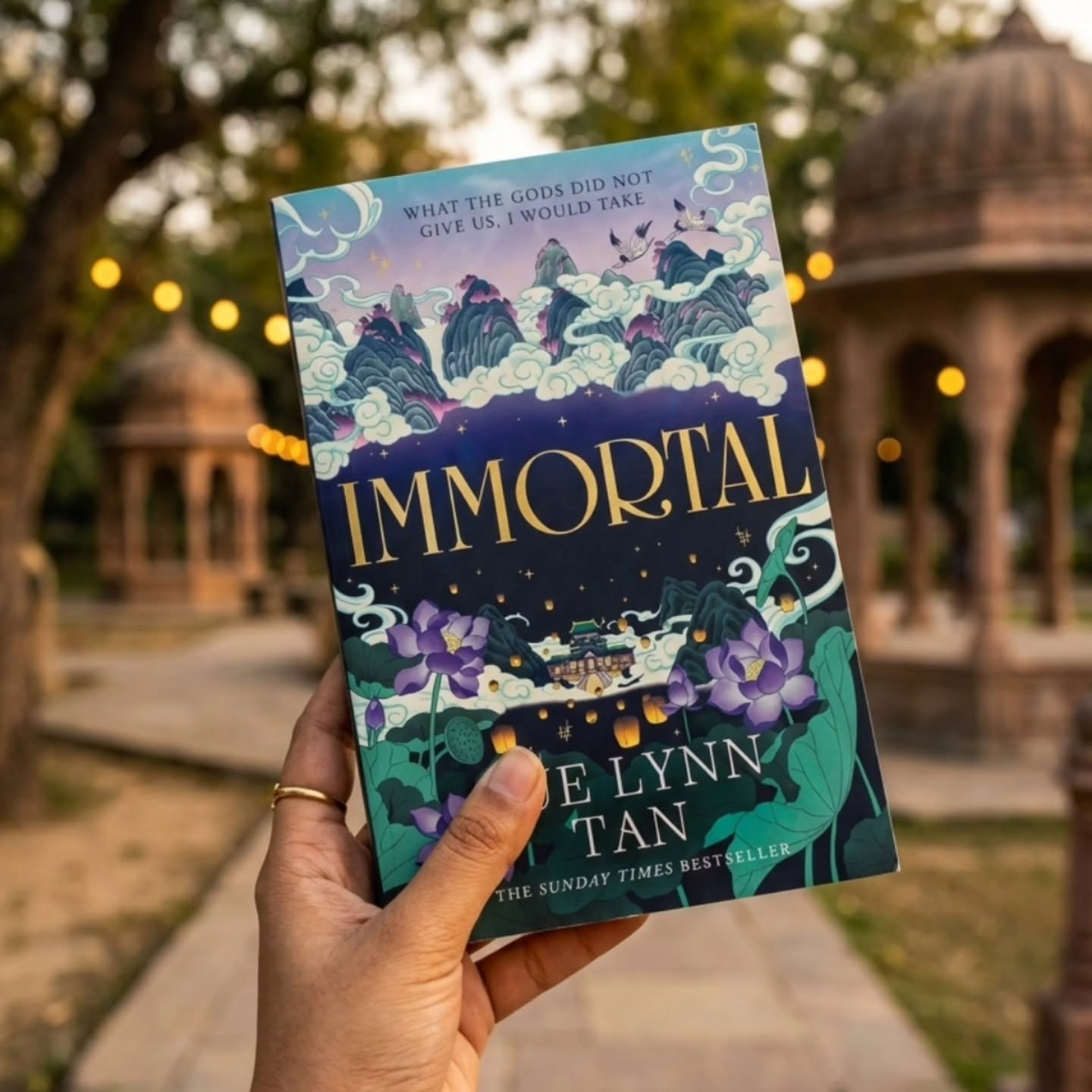
Immortal
-------------------------------------
Author: Sue Lynn Tan
Published: 2025
Genre: Fantasy
-------------------------------------
IBC Editorial Rating: 3.5/5
This book is handpicked by the IBC Editorial Team. If you are an author, publisher, or reader and would like to have a book reviewed by IBC, you may reach us at editorial@indianbookclub.com — we’ll be happy to review it.
-------------------------------------
Editorial Review:
Some burdens arrive with a crown, and then there are the ones no coronation prepares you for. Liyen inherits a kingdom already on its knees — poisoned by an act of desperate love, stripped of its protections, and suddenly, catastrophically, on the wrong side of an immortal queen's fury. To save her people, she must enter a world that was never built for humans and negotiate with the one figure she has every reason to fear: the God of War himself. Immortal is Sue Lynn Tan's return to the luminous mythological landscape she established in Daughter of the Moon Goddess — but this is an entirely new story, built around an entirely new kind of heroine. Lush, politically intricate, and threaded through with a romance that earns every complication it creates, this is epic fantasy that understands that the most dangerous battles are rarely the ones fought with weapons.
-------------------------------------
Book Summary:
Liyen has always known what her life would require of her. As heir to Tianxia, she is bound by centuries of obligation — her kingdom's pledge to serve the immortals who once shielded them from devastation they dare not risk repeating. It is an arrangement built on fear dressed as gratitude, and Liyen has accepted it the way you accept anything that has always been true: without examining it too closely. Then her grandfather steals an enchanted lotus to save her life, and everything collapses. The immortal queen's response is immediate and merciless. The God of War is dispatched. Tianxia suffers. And Liyen, ascending a throne inherited under the worst possible circumstances, makes a vow that reframes everything: she will end her kingdom's subjugation, whatever it costs her. When summoned to the Immortal Realm, she goes not as a supplicant but as someone paying close attention — learning the architecture of a world designed to remain opaque to her, searching for leverage, and trying to build an alliance in a place where trust is the one resource she cannot afford to spend carelessly. The only alliance that offers real possibility requires working alongside Zhangwei, the God of War — the man who attacked her kingdom, the man she should despise without qualification. Their dynamic builds with patience and consequence. The attraction that develops is not framed as weakness or betrayal — it is the specific danger that arrives when two people with every reason to distrust each other begin, slowly and against their better judgement, to see each other clearly. As darker forces gather and the threat to Tianxia deepens, every alliance, every secret, and every feeling she is trying to resist become impossible to separate from each other.
-------------------------------------
Key Takeaways:
- "Inherited obligation and the courage to rewrite it": Liyen was born into her kingdom's subjugation, as most people are born into the constraints that shape them. The novel asks whether she can dismantle what has always been — and what it costs when she tries. - "Love as political liability": The romance never exists in isolation from its consequences. Liyen's feelings for Zhangwei are a potential betrayal of the people depending on her clarity, and Tan takes that tension seriously. This gives the central relationship genuine stakes beyond the personal. - "Protection versus control": The immortals' historical role as protectors has calcified into something closer to dominion. The novel is quietly attentive to how that transformation happens — how power, once granted for good reasons, justifies its own continuation long after those reasons have expired. - "The human in an inhuman world. Liyen's mortality is her greatest vulnerability in a realm that operates on a different timescale entirely. But it is also the novel's moral compass. She is the only character for whom the consequences are final, which makes her courage the more remarkable.
-------------------------------------
Iconic Lines, Scenes & Characters:
- Liyen is stubborn in the way great fantasy protagonists need to be — from conviction, not recklessness. Her vulnerability as a human navigating an immortal world is never played as weakness. She is defined entirely by what she chooses to do anyway. - Zhangwei justifies the brooding archetype by giving it genuine psychological depth. His severity has origins, his protectiveness has history, and each layer of understanding is earned rather than given — which makes each one land. - The Immortal Realm is built with the confidence of someone who loves it. Ethereal, politically layered, and vivid enough to feel inhabitable — its beauty is never decorative. It carries meaning and conceals danger in equal measure. - The dialogue is one of the novel's quiet pleasures. Tan writes exchanges that are also negotiations, declarations that are also concealments. The best scenes live in the space between what is said and what is very carefully not.
-------------------------------------
Who Should Read This:
Immortal is for readers who want their fantasy substantial — world-building that rewards immersion, politics with genuine weight, and a romance that exists within the story's larger concerns rather than beside them. Readers drawn to enemy-to-lovers dynamics in high-fantasy settings will find this one handled with more seriousness and consequence than the trope usually receives. An honest note: the early sections ask for patience while the world establishes itself. Readers who find political intrigue as compelling as personal drama will be rewarded. Those reading primarily for romance may find the novel's ambitions occasionally demanding. But for those who respond to writing that is beautiful at the sentence level as well as the structural one, Immortal offers pleasures that linger long after the final page.
************************
IBC Editorial Note:
This review is part of the Indian Book Club’s editorial initiative to spotlight books that inspire, inform, and leave a lasting impact on readers. Every title featured is carefully handpicked and reviewed by the IBC Editorial Team to maintain quality, authenticity, and literary value. If you are an author, publisher, or reader and would like to submit a book for review, we’d be delighted to hear from you. Please write to us at: editorial@indianbookclub.com Our team personally evaluates each submission, and selected books are featured as official IBC Editorial Reviews on our platform.