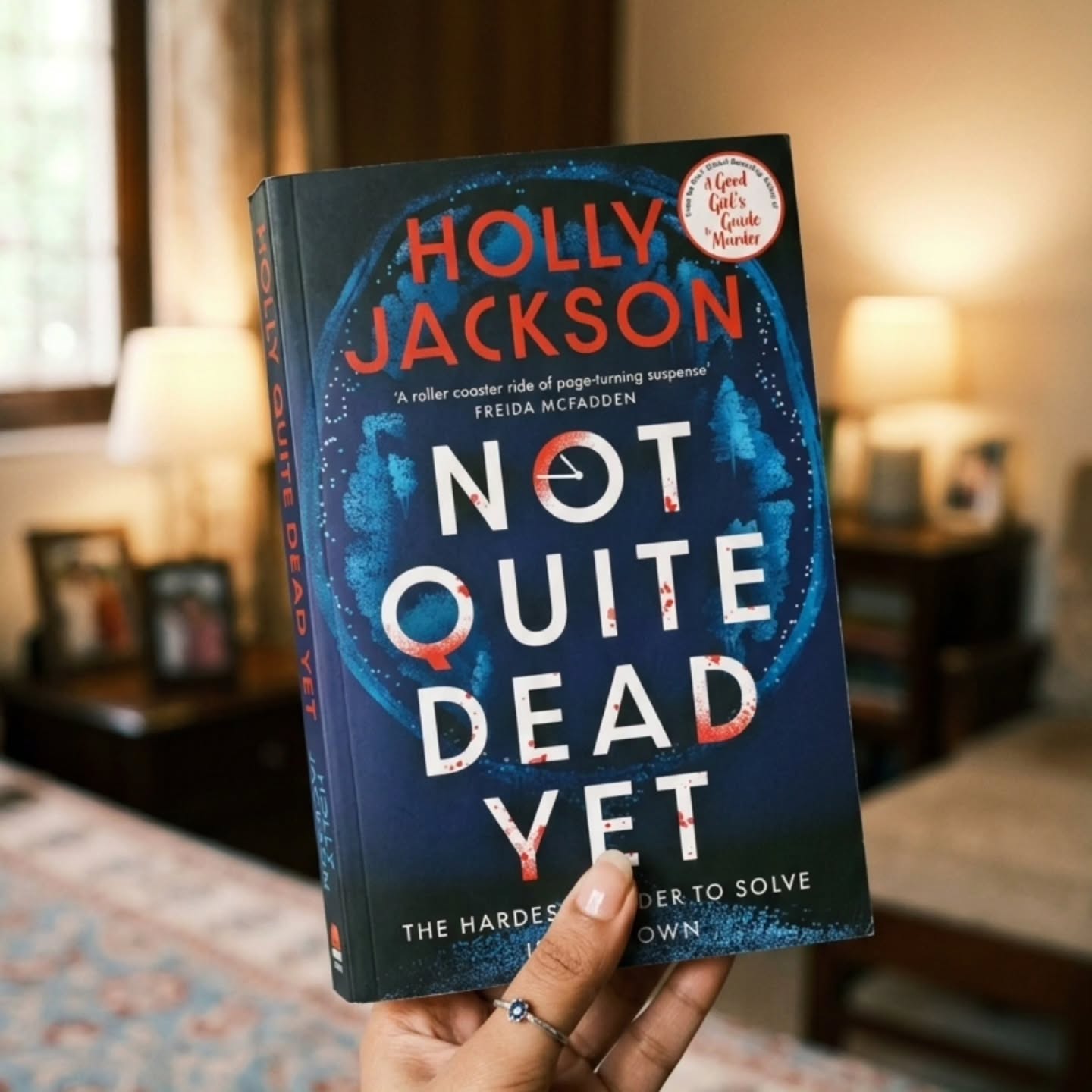
Not Quite Dead Yet
-------------------------------------
Author: Holly Jackson
Published: 2024
Genre: MysteryandThriller
-------------------------------------
IBC Editorial Rating: 4/5
This book is handpicked by the IBC Editorial Team. If you are an author, publisher, or reader and would like to have a book reviewed by IBC, you may reach us at editorial@indianbookclub.com — we’ll be happy to review it.
-------------------------------------
Editorial Review:
Most people put off living until tomorrow. Jet Mason has made an art form of it. At twenty-seven, she has spent her life in comfortable suspension — never quite starting, never quite finishing, always assuming there is more time. Then someone takes that time away from her. After a violent Halloween attack leaves her with a catastrophic brain injury and a doctor's verdict she cannot appeal, Jet has exactly seven days before an aneurysm ends everything she kept meaning to begin. Not Quite Dead Yet is Holly Jackson doing what she does best — constructing a mystery that moves like a countdown and hits like a gut punch — but it is also something more unexpected: a deeply human story about the life we defer, the people we underestimate, and what it means to finally, urgently, show up for yourself when you have almost run out of chances.
-------------------------------------
Book Summary:
Jet Mason has never thought of herself as someone with enemies. She is the daughter of one of Woodstock, Vermont's wealthiest families — comfortable, unhurried, and perpetually waiting for her real life to begin. There is always a later, always a next year, always some future version of herself who will be braver, more decisive, more present than the one currently occupying her days. She has time. She has always had time. On Halloween night, someone decides otherwise. The attack is sudden and unseen. Jet sustains a brain injury severe enough that her doctor delivers the verdict without softening it: within seven days, a dormant aneurysm will rupture. There is nothing to be done. The countdown has already begun. What Jackson constructs from this premise is a mystery with genuine urgency built into its architecture. Jet, faced with the certainty of her own death, finds herself doing something she has avoided for most of her adult life: paying attention. To the people around her. In the family dynamics, she has always accepted without examining. To the ex-best friend who became her sister-in-law in circumstances that were never entirely comfortable. To the former boyfriend, whose position in her life she never properly resolved. To the question of who, among all of them, wanted her dead badly enough to act. The investigation is conducted with Jet's childhood friend Billy as her only ally — a partnership that carries its own emotional weight, its own history, its own quietly developing significance. Billy is steady where Jet is impulsive, grounded where she is scattered, and his presence alongside her in these final days gives the novel its warmest and most affecting through-line. Jackson's structure is immaculate. Short, propulsive chapters create the sense of a clock running down, and the mystery itself is layered with the kind of craft that makes you feel perpetually close to the answer without quite arriving there. The red herrings are earned rather than cheap, the family dynamics are rendered with genuine complexity, and the Woodstock, Vermont setting — autumnal, atmospheric, carrying the particular quiet menace of a small town where everyone's secrets are adjacent to everyone else's — is exactly the right landscape for a story about what lives beneath the surface of comfortable lives. There is also, woven throughout, something more unexpected than the thriller mechanics: a portrait of a woman reckoning, too late and not too late at all, with the life she has been postponing. Jet's journey is not simply about solving a crime. It is about finally finishing something. And that dimension — the human one, beneath the mystery — is what transforms the novel from a very good thriller into something that lingers.
-------------------------------------
Key Takeaways:
- "The cost of deferral": Jet's defining characteristic, before the attack, is her habit of putting things off. Her life has been lived in the future tense — she will do it later, she will start soon, she has time. The novel's great emotional argument is that the attack does not change who Jet is so much as it removes the excuse that allowed her to avoid it. The urgency is new. The need was always there. - "Looking clearly at the people closest to us": One of the novel's most psychologically astute moves is the way it frames Jet's investigation. She has spent years surrounded by these people — her family, her former friends, her past loves — without truly seeing them. The knowledge that one of them wants her dead forces a clarity she has never previously allowed herself. What she discovers about the people she thought she knew is, in some ways, more disturbing than the crime itself. - "Childhood friendship and the people who know us longest": Billy is not simply a plot device or a romantic interest. He represents a particular kind of knowing — the knowledge that accumulates over decades, that predates the performances we develop for adult life, that sees through the versions of ourselves we construct for other people's comfort. His presence in Jet's final week carries the novel's most tender emotional charge. - "Family, inheritance, and the weight of wealth": The Mason family's privilege is not incidental to the story — it shapes every relationship within it. The novel is quietly attentive to what growing up wealthy does to a person's sense of urgency, accountability, and self-knowledge. Jet's prolonged adolescence, her comfortable suspension, is in part a product of a life in which consequences have always been softened by money. - "Grief, urgency, and the decision to finally begin": There is a particular kind of grief in the novel that is not about death approaching but about the life not yet lived. Jet mourns futures she never quite reached for, relationships she let atrophy, the person she kept meaning to become. The mystery gives her something to solve. The emotional journey gives her something more: the chance to stop waiting.
-------------------------------------
Iconic Lines, Scenes & Characters:
- The premise as emotional engine. The seven-day countdown is not just a thriller device — it is a philosophical one. Every scene is weighted by what Jet is losing, and the ticking clock gives even the quieter moments an intensity that most mysteries have to work much harder to generate. You feel the days passing. You feel the narrowing. - Jet and Billy. Their dynamic is the novel's beating heart. There is history between them — the kind that does not expire, that survives years of distance and changed circumstance and the particular sadness of two people who did not find their way to each other when they should have. Watching them navigate the investigation while quietly navigating each other is where the novel earns its most genuine emotional responses. - The family dynamics. The Masons are drawn with the kind of specificity that makes fictional families feel like ones you have met. The controlling mother, the ex-best friend turned sister-in-law, the unresolved former relationship — each of these figures carries enough complexity to sustain genuine suspicion, and the novel manages the difficult trick of making you care about the relationships even as it positions them as potential threats. - The mystery's construction. Jackson's plotting is precise and confident. The reader is kept perpetually adjacent to the truth — close enough to feel clever, far enough to be genuinely surprised. The final reveal lands with impact, not because it comes from nowhere but because it was, in retrospect, exactly right. The kind of ending you want to immediately discuss with someone. - The dog letter. To say more would be to say too much. But readers who have encountered it will understand why it is mentioned here, and readers who have not should be gently warned to have something nearby for the tears they will not entirely see coming.
-------------------------------------
Who Should Read This:
Not Quite Dead Yet is for readers who want their mysteries to mean something — who need the emotional stakes to match the narrative ones, and who find a ticking clock more compelling when it is counting down to something human rather than simply something dangerous. If you have ever read a Holly Jackson novel and emerged slightly wrecked but entirely satisfied, this will feel like familiar territory taken somewhere new. The thriller mechanics are sharp enough to satisfy genre devotees, but the novel's emotional register — the deferred life, the complicated family, the childhood friend who stayed — gives it a reach beyond its category. It will work for readers who do not typically gravitate toward mysteries, provided they are willing to let the character work carry them through the early pages, which ask for a little patience before the urgency fully ignites. A note for those who like to know what they are walking into: this novel will make you laugh, genuinely and unexpectedly. It will also make you cry in a way that feels earned rather than manipulated — the kind of crying that comes from recognising something true. Come prepared for both. Come prepared, also, to think about your own deferred life, your own Billy, your own list of things you keep meaning to begin. The best thrillers solve a crime. This one asks you a question. And the question, it turns out, is the harder one to shake.
************************
IBC Editorial Note:
This review is part of the Indian Book Club’s editorial initiative to spotlight books that inspire, inform, and leave a lasting impact on readers. Every title featured is carefully handpicked and reviewed by the IBC Editorial Team to maintain quality, authenticity, and literary value. If you are an author, publisher, or reader and would like to submit a book for review, we’d be delighted to hear from you. Please write to us at: editorial@indianbookclub.com Our team personally evaluates each submission, and selected books are featured as official IBC Editorial Reviews on our platform.