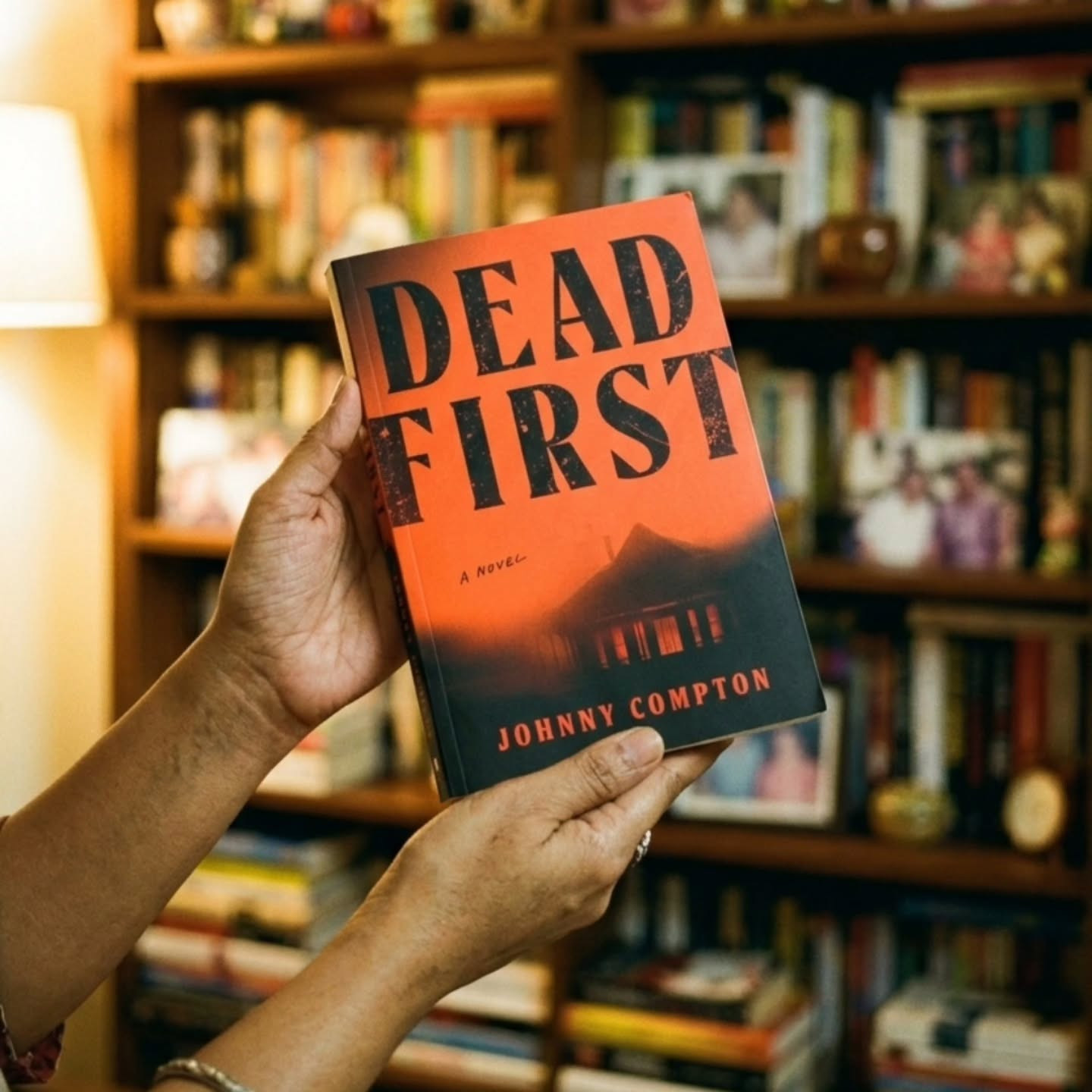
Dead First
-------------------------------------
Author: Johnny Compton
Published: 2026
Genre: Horror
-------------------------------------
IBC Editorial Rating: 4/5
This book is handpicked by the IBC Editorial Team. If you are an author, publisher, or reader and would like to have a book reviewed by IBC, you may reach us at editorial@indianbookclub.com — we’ll be happy to review it.
-------------------------------------
Editorial Review:
Some cases arrive with a fee attached. This one arrives with a body that refuses to stay dead. When private investigator Shyla Sinclair accepts an invitation to the sprawling Texas mansion of billionaire Saxton Braith, she expects strangeness — wealthy clients rarely call on PIs for ordinary reasons. What she does not expect is to watch a man survive an iron rod through the skull, and then be offered millions to find out why. Dead First is atmospheric Southern Gothic horror at its most unsettling: a novel about immortality, leverage, and the buried past that will always, eventually, find its way back to the surface. Johnny Compton constructs a world that feels genuinely dangerous from its opening pages, and populates it with characters who carry their own secrets as heavily as the mysteries they are hired to solve.
-------------------------------------
Book Summary:
Shyla Sinclair is not easily rattled. As a private investigator, she has learned to walk into unfamiliar rooms with her guard up and her instincts sharp. But nothing in her professional history has prepared her for the night she arrives at Saxton Braith's mansion and watches his assistant drive a metal rod through the back of his skull — and then watches Braith's face slowly, horribly, stitch itself back together, as though the laws of biology are simply a set of guidelines he has chosen not to follow. Braith, it emerges, cannot die. He does not know why. His memories of his own past are fragmentary, unreliable, full of gaps that seem less like ordinary forgetting and more like something deliberately obscured. He wants Shyla to investigate him — to dig into the history he cannot access himself and bring whatever is buried there into the light. The fee he is offering is life-changing. The alternative, he makes clear, is that he will reveal what he knows about her — and what he knows is enough to destroy her. Shyla takes the job. Not entirely by choice, but then very few of the most consequential decisions in life are made entirely freely. What follows is an investigation that moves steadily from the uncomfortable into the genuinely terrifying. Shyla is joined by Jihn, her ex-girlfriend and a clairvoyant of considerable power, whose ability to communicate with the dead proves less of an advantage and more of a liability the deeper they go. Because the truth about Braith — his origins, his condition, and his real reasons for hiring Shyla specifically — is not simply strange. It is the kind of strange that changes the shape of everything around it. Compton is careful with his plotting. The novel layers its reveals deliberately, each one shifting the context for what came before, and the question of Braith's true motivation remains genuinely open for much of the book. He is not straightforwardly villainous, nor is he sympathetic in any comfortable way. He is something more interesting: a man whose immortality has not made him powerful so much as it has made him patient, and whose patience has curdled into something that resembles a plan. Shyla, meanwhile, is carrying her own weight. Her past — rooted in her childhood, connected to the secrets Braith is using against her — gives the investigation an emotional dimension that elevates it beyond genre. She is not simply solving a mystery. She is excavating herself.
-------------------------------------
Key Takeaways:
- "The corruption of power over time": Immortality, in Compton's hands, is not a gift. It is an accumulation of knowledge, of leverage, of the particular kind of detachment that comes from watching everything and everyone around you expire while you persist. Braith is a study of what power does to a person when it is never checked by mortality, and the novel's horror is rooted as much in that psychological portrait as in its supernatural machinery. - "Secrets as currency": The central transaction of the novel — Braith knows Shyla's secret, and uses it to buy her compliance — establishes a thematic economy that runs throughout the book. Almost every significant relationship here is shaped by asymmetric knowledge: someone knows something the other does not, and that knowledge becomes leverage, or protection, or both. It is a novel acutely interested in what we conceal and why, and what it costs us when someone else gains access to it. - "The past as an active force": Braith's fragmented memory is the novel's central mystery, but it is also its central metaphor. The buried past does not stay buried — it exerts pressure, shapes behaviour, and eventually, inevitably, resurfaces. This is true of Braith's history. It is equally true of Shyla's. The novel suggests that the real horror is not the supernatural — it is the impossibility of genuine escape from what you have done or endured. - "Trust under coercion": Shyla does not choose to trust Braith. She is compelled into proximity with him, and what develops between them — not warmth, exactly, but something more complex than simple antagonism — is one of the novel's most quietly unnerving achievements. Compton is interested in what happens to human connection when it is initiated through threat rather than choice. - "Female resilience in the face of institutional danger": Shyla operates in a world that is not built to protect her, and her survival depends on intelligence and resourcefulness rather than any systemic support. Her tenacity is not framed as exceptional — it is framed as necessary. The novel respects her for it without making her invulnerable.
-------------------------------------
Iconic Lines, Scenes & Characters:
- The opening demonstration. The scene in which Braith's immortality is proved — in the most viscerally direct way imaginable — sets the novel's tone with absolute confidence. It is shocking without being gratuitous, and its real effect is not the horror of the moment but the slow dread that follows: if this is what he is willing to show you, what is he not showing you? - Shyla Sinclair is one of the novel's most significant achievements. She is tough and capable in the ways that genre demands, but Compton gives her an interior life that earns genuine emotional investment. Her secrets — withheld carefully from the reader as well as from the other characters — give her a depth and a vulnerability that make every dangerous situation feel genuinely costly. When she is frightened, you feel it. When she is determined, you feel that too. - Jihn, Shyla's ex-girlfriend and psychic collaborator, adds a dimension to the investigation that the novel uses thoughtfully. Her ability to commune with spirits is not deployed as a convenient plot mechanism — it opens doors that the investigation would rather have kept closed, and her presence complicates Shyla's emotional landscape in ways that run parallel to the central mystery. - Braith himself resists easy categorisation, and that resistance is what makes him genuinely unsettling. He is not the monstrous villain the setup might suggest. He is something harder to dismiss — a man with a plan, a past, and a patience that has had centuries to develop. His scenes with Shyla crackle with a tension that is part threat, part something neither of them has quite named. - The mansion as atmosphere. Compton renders Braith's sprawling Texas estate with a Gothic attentiveness that makes the setting feel like a character in its own right. The physical space — its scale, its isolation, its sense of having absorbed decades of secrets into its walls — generates a persistent dread that underpins even the novel's quieter scenes.
-------------------------------------
Who Should Read This:
Dead First is for readers who want their horror to do more than frighten — who want it to think, to characterise, to leave something behind once the adrenaline has faded. The supernatural premise is inventive and executed with genuine atmosphere, but the novel's lasting impression is less about its scares than about Shyla: a protagonist with enough complexity, history, and hard-won competence to sustain a series many books long. Readers drawn to the intersection of noir and horror will find Compton's blend of private investigator procedural and Gothic supernatural particularly satisfying. The Texas setting gives the novel a specific regional texture that distinguishes it from more anonymous genre entries, and the Southern Gothic atmosphere is handled with evident care. A note of honest guidance: this is a novel that rewards patience with character over momentum of plot. The dread builds slowly and deliberately, and readers who prefer their horror immediate and relentless may find the pacing asks more of them than they expected. But for those willing to settle into its atmosphere — to let Shyla's world and its dangers accumulate at the novel's own pace — the experience is rich, layered, and genuinely unsettling in the ways that last. This is the kind of horror that follows you quietly, rather than chasing you loudly, and there is a strong case that that is the more effective kind.
************************
IBC Editorial Note:
This review is part of the Indian Book Club’s editorial initiative to spotlight books that inspire, inform, and leave a lasting impact on readers. Every title featured is carefully handpicked and reviewed by the IBC Editorial Team to maintain quality, authenticity, and literary value. If you are an author, publisher, or reader and would like to submit a book for review, we’d be delighted to hear from you. Please write to us at: editorial@indianbookclub.com Our team personally evaluates each submission, and selected books are featured as official IBC Editorial Reviews on our platform.