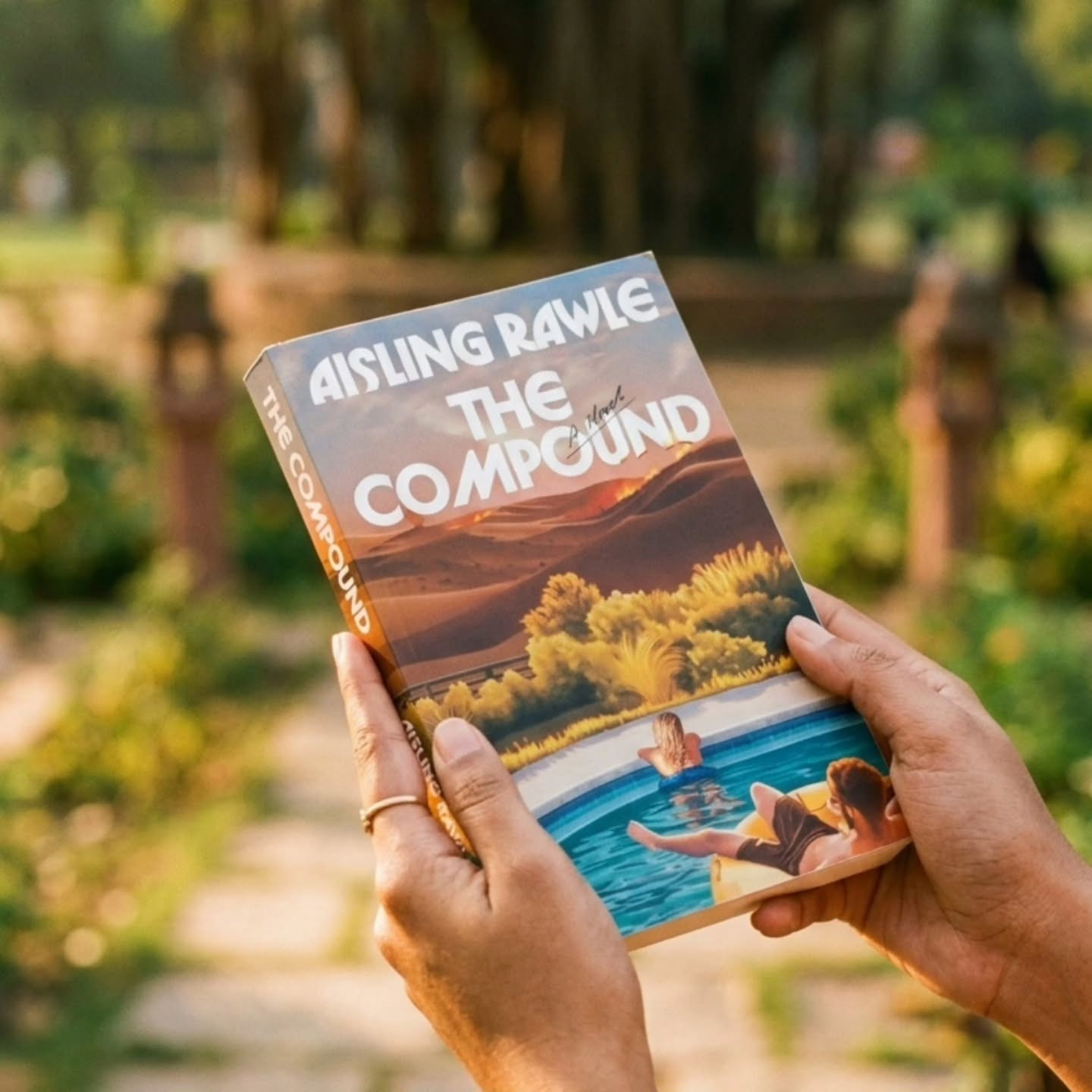
The Compound
-------------------------------------
Author: Aisling Rawle
Published: 2024
Genre: ScienceFiction(Sci-Fi)
-------------------------------------
IBC Editorial Rating: 4/5
This book is handpicked by the IBC Editorial Team. If you are an author, publisher, or reader and would like to have a book reviewed by IBC, you may reach us at editorial@indianbookclub.com — we’ll be happy to review it.
-------------------------------------
Editorial Review:
What would you sacrifice for a better life — and how much of yourself could you lose before you stopped recognising who you were? The Compound drops its readers into the searing heat of a desert reality show with the visceral immediacy of someone who has never once flinched from an uncomfortable question. Lily is young, sharp, and entirely aware that the world waiting for her outside these walls is not one she is in any hurry to return to. Inside the compound, there are cameras, competitors, and the constant low hum of surveillance. There is also something far more unsettling: the slow, creeping realisation that the game and the players are becoming impossible to separate. Aisling Rawle's debut is taut, propulsive, and uncomfortably timely.
-------------------------------------
Book Summary:
Lily wakes up in a house she does not recognise, in a desert she cannot escape, surrounded by nineteen strangers who are all, like her, here to compete. The show is called The Compound. The rules are deceptively simple: couple up, complete challenges, earn rewards, and do not — under any circumstances — find yourself without a bedmate when the lights go out. Sleep alone, and you are gone. The rewards on offer range from the frivolous to the foundational. Champagne and lipstick sit alongside food, appliances, and something as basic as a functioning front door. This is by design. The show does not simply test desire — it engineers dependency, blurring the line between luxury and survival until contestants can no longer clearly distinguish between the two. For Lily, who works as a shop assistant in a life she finds quietly suffocating, the compound is not a punishment. It is the most alive she has ever felt. Rawle constructs this world with the confidence of someone who understands exactly what she is doing. The compound becomes a pressure cooker — physically isolated, relentlessly observed, stripped of the usual social buffers that allow people to maintain the performance of their better selves. As the weeks pass, the dynamics between contestants shift. Friendships calcify into alliances. Attraction curdles into strategy. The violence that was always latent in the show's format begins to surface in ways the producers seem not merely to permit but to encourage. Outside the compound's walls, we catch glimpses of a world in collapse — wars, environmental devastation, a civilisation fraying at its edges. Rawle is deliberate in her restraint here. We are not given the full picture of what is happening beyond the desert. We are given only what Lily knows, which is just enough to understand why she, and so many others, chose to come here in the first place. When the world outside is falling apart, a closed system with clear rules and available rewards can feel like the safest place to be. That is part of what makes this novel so quietly devastating. As the contestant numbers dwindle and the final stages approach, the rules change entirely. Physical boundaries dissolve. The show's pretence of civility is abandoned. And Lily — who entered this compound with her eyes open, convinced she understood what she was signing up for — begins to understand the true cost of what she has agreed to.
-------------------------------------
Key Takeaways:
- "Survival and the performance of the self": The compound demands that its contestants be watchable at all times — attractive, compelling, strategically vulnerable. Lily is acutely aware of her own image and what it is doing for her in this environment. The novel asks, with genuine unease, how much of what we present to others is authentic and how much is simply the version of ourselves most likely to keep us safe. - "Consumerism as control": The reward system is the novel's sharpest idea. By making food and shelter contingent on performance — by placing them alongside luxury items as though they are simply different points on the same spectrum — the show reveals something true and disturbing about the world that created it. Desire is manufactured. Need is weaponised. And the contestants, like the consumers they represent, keep playing. - "Class, escapism, and the seduction of elsewhere": Lily does not experience the compound the way a wealthier contestant might. For her, the rewards are not entertainment — they are access. The novel understands this distinction deeply and refuses to judge her for it, even as it traces what that desperation costs her. - "The collapse of the outside world as backdrop and mirror": The dying world beyond the desert is not an incidental detail. It is the engine of everything. The compound exists because people need somewhere to go. The show exists because people need something to watch. And both of those needs — for escape, for spectacle — are symptoms of the same civilisational exhaustion. - "The line between desire and desperation": As intimacy deepens among the contestants, the novel grows increasingly interested in what is real and what is strategic. Can a genuine connection exist inside a system designed to exploit it? And if it does — if something true emerges between two people in an environment engineered for performance — does the context contaminate it?
-------------------------------------
Iconic Lines, Scenes & Characters:
- The reward structure itself is the novel's most unsettling and most brilliant invention. The normalisation of earning food and water alongside lipstick and champagne is handled without fanfare, which makes it all the more effective. You absorb it the way the contestants do — gradually, until it simply seems like the way things work. - Lily as narrator is a careful, considered choice. Her perspective is limited, and Rawle leans into that limitation rather than apologising for it. We see what Lily sees, want what she wants, and justify what she justifies. By the time her moral compass has shifted, so — almost imperceptibly — has ours. - The rule change at the final five is the novel's structural pivot point — the moment when the show removes its last pretence of safety, and the contestants must decide who they actually are when there are no longer any rules to hide behind. It is where the Lord of the Flies comparison earns its keep. - The world outside. Rawle's decision to keep the external dystopia deliberately vague is a risk that pays off. What we are given — fragments, implications, the visible desperation of people willing to compete for a front door — is more disturbing precisely because it is incomplete. We fill in the gaps with our own fears, and our own fears are more than adequate. - The compound as a character. The physical space — its house, its pool, its maze, its surrounding desert — is rendered with an almost architectural specificity that makes it feel oppressive even in its moments of superficial glamour. The maze, in particular, lingers. A structure designed not to keep people out, but to disorient the people within.
-------------------------------------
Who Should Read This:
The Compound will find its most immediate audience among readers who have ever watched a reality television show with equal parts fascination and discomfort — who have felt the pull of the spectacle and the guilt of the pull simultaneously. If you have ever wondered what it says about us that we watch, this novel is prepared to answer that question without letting either you or itself off the hook. It will also reward readers drawn to dystopian fiction that operates close to the present rather than at a speculative distance. This is not a novel about a distant future. It is a novel about a very near one — perhaps even a current one, reframed slightly so we can see it more clearly. A note for those who have encountered the comparison to Love Island meets Lord of the Flies: it is accurate, but it undersells the book's emotional intelligence. Yes, it moves like addictive television. Yes, it goes to dark places. But it is also a genuinely considered piece of fiction about class, desire, and what people are willing to endure when they have been given very few alternatives. Come for the premise. Stay for what it quietly, persistently refuses to let you look away from.
************************
IBC Editorial Note:
This review is part of the Indian Book Club’s editorial initiative to spotlight books that inspire, inform, and leave a lasting impact on readers. Every title featured is carefully handpicked and reviewed by the IBC Editorial Team to maintain quality, authenticity, and literary value. If you are an author, publisher, or reader and would like to submit a book for review, we’d be delighted to hear from you. Please write to us at: editorial@indianbookclub.com Our team personally evaluates each submission, and selected books are featured as official IBC Editorial Reviews on our platform.