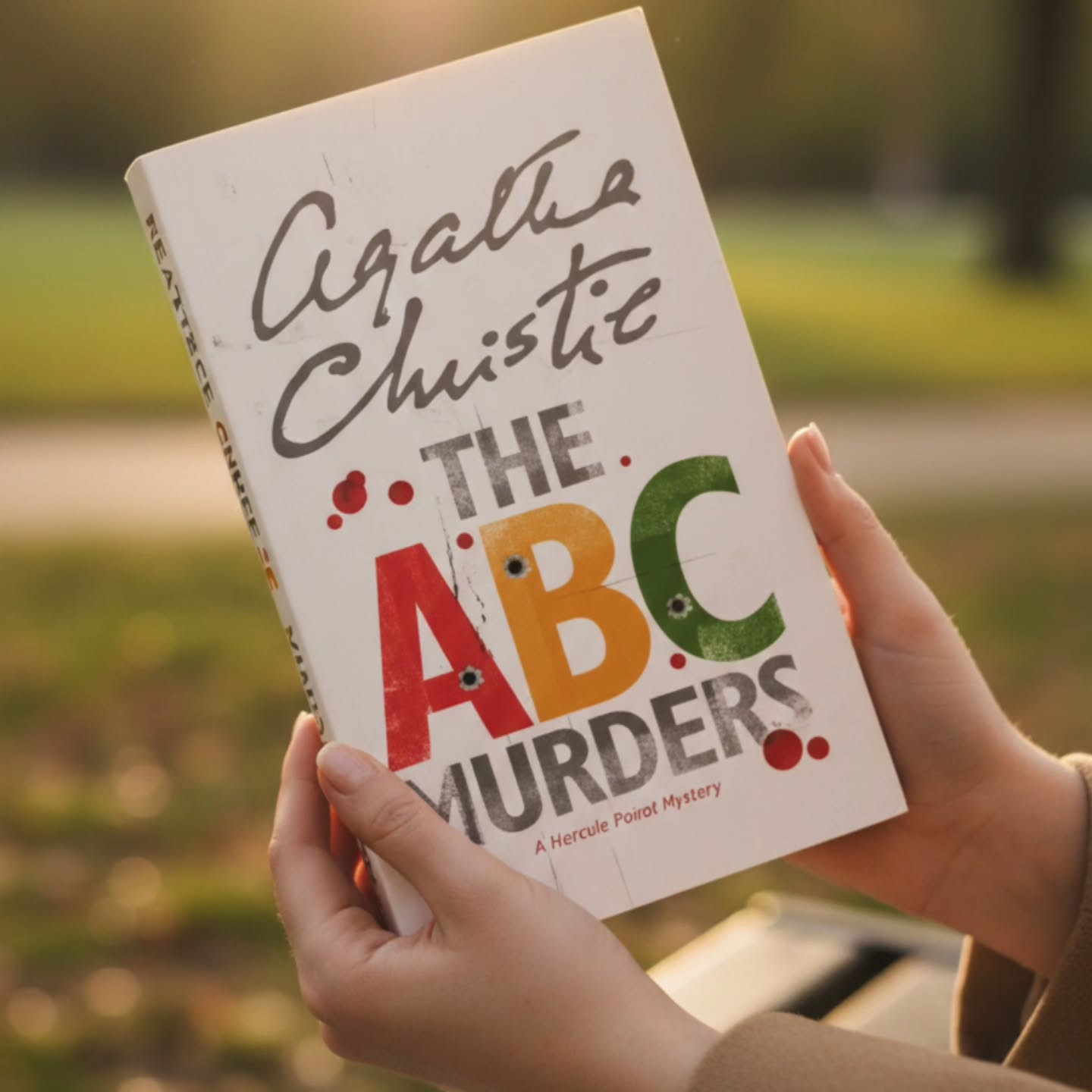
The ABC Murders
-------------------------------------
Author: Agatha Christie
Published: 1935
Genre: MysteryandThriller
-------------------------------------
IBC Editorial Rating: 4/5
This book is handpicked by the IBC Editorial Team. If you are an author, publisher, or reader and would like to have a book reviewed by IBC, you may reach us at editorial@indianbookclub.com — we’ll be happy to review it.
-------------------------------------
Editorial Review:
Agatha Christie's The ABC Murders presents Hercule Poirot with perhaps his most methodical adversary: a serial killer who announces his crimes in advance and leaves the ABC Railway Guide as his signature. When the Belgian detective receives a taunting letter predicting a murder in Andover, he finds himself in a macabre race against an opponent who kills alphabetically—Alice Asher in Andover, Betty Bernard in Bexhill, and the promise of more victims to follow. Unlike Christie's typical closed-room mysteries, this novel plunges Poirot into a manhunt across England as he attempts to decipher the pattern before the killer completes his deadly alphabet. The detective's famous "little grey cells" are tested not by a single puzzling death but by a series of seemingly random murders connected only by their alphabetical precision. Christie crafts a narrative that subverts her own formulas while delivering the intricate plotting and unexpected revelation her readers expect
-------------------------------------
Book Summary:
The ABC Murders opens with an audacious premise: Hercule Poirot receives a letter signed "ABC" that cryptically announces a murder will occur in Andover on a specific date. Despite the warning, Poirot cannot prevent the death of Alice Asher, an elderly shopkeeper bludgeoned in her tobacco shop. Beside her body, the killer leaves an ABC Railway Guide opened to Andover, establishing the calling card that will define the investigation. The methodical nature of the crime and the warning signal that Poirot faces an unusual adversary—one who wants the detective involved, perhaps to showcase his own brilliance. When a second letter arrives predicting another murder, this time in Bexhill, Poirot realizes he's dealing with a serial killer operating according to alphabetical logic. Betty Bernard, a young waitress, is strangled with her own belt on the beach, and again the ABC Railway Guide marks the scene. The pattern crystallizes: the victims' names and the murder locations follow alphabetical order, suggesting the killer is working through a predetermined sequence with chilling precision. Christie introduces Arthur Hastings as narrator, Poirot's long-time companion, who provides the reader's perspective on the investigation. As the murders continue—a third victim in Churston—Poirot assembles those connected to the deceased, forming an informal investigative committee. This group includes family members of the victims, each grappling with grief and the terrifying randomness of being selected by alphabetical coincidence. The detective's approach emphasizes psychology over physical evidence, as he attempts to understand why someone would commit murders dictated by the alphabet rather than personal motive. The investigation reveals victims with no apparent connection beyond the alphabetical coincidence of their names and locations. Alice Asher was elderly and unremarkable; Betty Bernard was young and beautiful; the third victim presents yet another contrast. This randomness proves more unsettling than murders motivated by inheritance, revenge, or passion—the killer seems to select victims arbitrarily, making everyone whose name fits the pattern a potential target. Christie depicts Poirot as unusually rattled by this case. His traditional methods—gathering suspects in a room, exposing contradictions in testimony, revealing hidden motives—seem inadequate against an adversary who kills strangers according to external logic rather than personal connection. The famous detective appears vulnerable, aware that his inability to predict the next victim means more deaths are inevitable. This portrayal adds psychological depth to a character often presented as infallible. As the alphabet progresses and bodies accumulate, pressure mounts on both the police and Poirot. The press sensationalizes the murders, the public panics, and anyone whose name corresponds to the next letter lives in fear. Christie captures the social disruption caused by a serial killer in 1930s England, a society unaccustomed to such seemingly random violence. The investigation includes a traveling salesman named Alexander Bonaparte Cust, who appears tangentially connected to multiple murder locations. His presence introduces questions about whether the killer operates alone or uses accomplices, and whether the alphabetical pattern might be misdirection concealing a more traditional motive. Christie skillfully manages reader suspicion, making Cust both obviously suspicious and potentially too obvious to be the actual murderer. Poirot's breakthrough comes not from discovering new evidence but from reframing his understanding of the entire pattern. The revelation Christie delivers recontextualizes everything readers have witnessed, demonstrating her signature ability to hide crucial information in plain sight while playing fair with clues. The solution involves recognizing that the most elaborate aspect of the crimes—the alphabetical pattern itself—serves a specific purpose that becomes clear only when approached from the correct angle. The resolution provides intellectual satisfaction while acknowledging the human cost of the killer's scheme. Christie does not sensationalize violence but treats each victim as a person whose death matters, even as the plot mechanics require viewing them as pieces in a larger puzzle.
-------------------------------------
Key Takeaways:
- "Pattern Recognition Versus Misdirection": Christie explores how elaborate patterns can obscure rather than illuminate truth, with the alphabetical murders functioning as both genuine structure and deliberate distraction. The novel demonstrates that the most obvious explanation for a pattern may itself be part of a more sophisticated deception. - "The Vulnerability of Detective Genius": By presenting Poirot as genuinely challenged and momentarily defeated by the case's structure, Christie humanizes her detective and raises stakes beyond intellectual puzzle-solving. The narrative suggests that even brilliant minds can be stymied when adversaries understand and exploit their methodological assumptions. - "Random Violence and Social Disruption": The apparent randomness of victim selection creates broader social anxiety than murders with comprehensible motives, as anyone fitting the pattern becomes a potential target. Christie captures how serial violence destabilizes communities by making death seem arbitrary rather than connected to individual actions or relationships. - "The Construction of Criminal Identity": The novel interrogates whether killers are born with inherent evil or whether circumstances and psychology combine to create murderous behavior. Christie presents criminality as more complex than simple moral failing, particularly through characters whose mental states blur lines between culpability and victimhood. - "Methodology Versus Intuition in Detection": Poirot's struggle with this case highlights tensions between systematic investigation and psychological intuition, as the alphabetical pattern seems to reward methodical analysis but ultimately requires imaginative reframing. The resolution demonstrates that solving complex crimes requires both rigorous logic and creative thinking capable of questioning fundamental assumptions.
-------------------------------------
Iconic Lines, Scenes & Characters:
- "The Taunting Opening Letters": The killer's decision to warn Poirot of impending murders establishes an adversarial relationship that personalizes the crimes beyond random violence. This device transforms the investigation into a battle of wits where the killer seemingly desires recognition and engagement from his pursuer. - "Poirot's Uncharacteristic Uncertainty": Scenes depicting the detective's frustration and self-doubt provide rare glimpses of vulnerability in a character typically portrayed as supremely confident. Christie uses this emotional dimension to heighten tension and demonstrate that this case represents a genuine threat to Poirot's reputation and self-conception. - "The ABC Railway Guide as Calling Card": The killer's signature object becomes a recurring motif that is simultaneously a clue and a red herring, functioning within the plot's logic while also serving thematic purposes. The guide's ubiquity in 1930s British life makes it both unremarkable and symbolically significant. - "Alexander Bonaparte Cust as Tragic Figure": Without revealing his precise role, Cust represents Christie's nuanced approach to criminal psychology and culpability, refusing simple categorizations of guilt and innocence. His character demonstrates how circumstances can trap individuals in situations where agency becomes ambiguous. - "The Assembled Victims' Families": Poirot's decision to gather relatives of the deceased creates an unusual investigative structure, transforming strangers connected only by tragedy into a temporary community. These scenes explore how grief manifests differently across class, age, and personality while maintaining focus on the central mystery. - "The Climactic Revelation's Logical Elegance": Christie's solution demonstrates her skill at constructing puzzles where the answer seems both completely unexpected and, in retrospect, the only possibility that accounts for all evidence. The reveal requires readers to simultaneously appreciate their own misdirection and recognize that sufficient clues existed throughout.
-------------------------------------
Who Should Read This:
The ABC Murders will particularly appeal to readers seeking classic Golden Age detective fiction that balances intricate plotting with psychological depth. Those who appreciate Agatha Christie's other Poirot novels will find this entry notable for its departure from her typical closed-circle mysteries, as the serial killer format and geographical scope create different narrative dynamics. The novel rewards readers who enjoy puzzle-solving alongside their fictional detectives, as Christie provides sufficient clues for observant readers to potentially solve the mystery before Poirot's revelation. Fans of serial killer narratives will find Christie's 1936 treatment of the subject matter interesting from both historical and literary perspectives. Written decades before serial killer fiction became a dominant crime subgenre, The ABC Murders approaches the concept with fresh eyes, focusing on pattern and psychology rather than graphic violence or procedural detail. Modern readers accustomed to forensic-heavy crime fiction may appreciate Christie's emphasis on logical deduction and psychological insight over technological investigation. Those using mystery novels as "palette cleansers" between other genres, as the reviewer notes, will find this book serves that function admirably. At approximately 250 pages in most editions, the novel provides a quick, intellectually engaging read that demands attention without requiring extended commitment. The straightforward prose and clear narrative structure make it accessible for readers seeking entertainment rather than literary challenge, though the plotting remains sophisticated enough to satisfy those wanting genuine puzzle-solving. Readers interested in historical fiction set in 1930s England will appreciate Christie's depiction of the era's social structures, transportation systems, and cultural attitudes. While the novel focuses primarily on mystery rather than historical detail, the setting is rendered authentically, providing glimpses of interwar British life. The railway system's centrality to both plot and daily life captures a specific moment in British history. However, prospective readers should be aware of certain limitations. The reviewer accurately notes that pacing issues occur in the middle sections, where Christie develops character backgrounds and investigative details that may feel repetitive or tangential to modern readers accustomed to faster narrative momentum. Those requiring constant action or plot development may find these sections tedious, though they serve important functions in establishing misdirection and providing clues. Additionally, some references and social attitudes reflect the novel's 1936 publication date. The reviewer mentions needing to research certain dated references, and contemporary readers may encounter casual classism, period-specific idioms, or social assumptions that require historical context. While Christie's work is notably less problematic than many contemporaries regarding race and gender, some language and attitudes will strike modern readers as products of their time. The romantic subplot, which the reviewer finds amusingly incongruous given the grim subject matter, represents Christie's tendency to include conventional elements even in unconventional mysteries. Readers who prefer their crime fiction undiluted by romance may find these elements distracting, though they occupy relatively minor space in the overall narrative. Those seeking graphic violence, psychological horror, or detailed criminal methodology will not find it here. Christie treats violence with restraint, focusing on intellectual puzzle-solving rather than visceral impact. The murders occur off-page or are described clinically, making this suitable for readers who enjoy crime fiction without explicit content but potentially disappointing for those wanting intensity or darkness. The ABC Murders ultimately speaks most powerfully to readers who appreciate detective fiction as an intellectual exercise, where satisfaction derives from watching a brilliant mind work through complex problems and experiencing the revelation that reframes everything. It is a novel for those who understand that the best mysteries hide their solutions in plain sight while maintaining fair play with readers, and who value elegant plotting over psychological realism or social commentary. Christie has crafted a mystery that respects reader intelligence while delivering genuine surprise, creating a reading experience that exercises the "little grey cells" without requiring the emotional investment demanded by darker, more psychologically intense crime fiction. For readers seeking a well-constructed puzzle wrapped in period charm, this novel delivers exactly what it promises.
************************
IBC Editorial Note:
This review is part of the Indian Book Club’s editorial initiative to spotlight books that inspire, inform, and leave a lasting impact on readers. Every title featured is carefully handpicked and reviewed by the IBC Editorial Team to maintain quality, authenticity, and literary value. If you are an author, publisher, or reader and would like to submit a book for review, we’d be delighted to hear from you. Please write to us at: editorial@indianbookclub.com Our team personally evaluates each submission, and selected books are featured as official IBC Editorial Reviews on our platform.