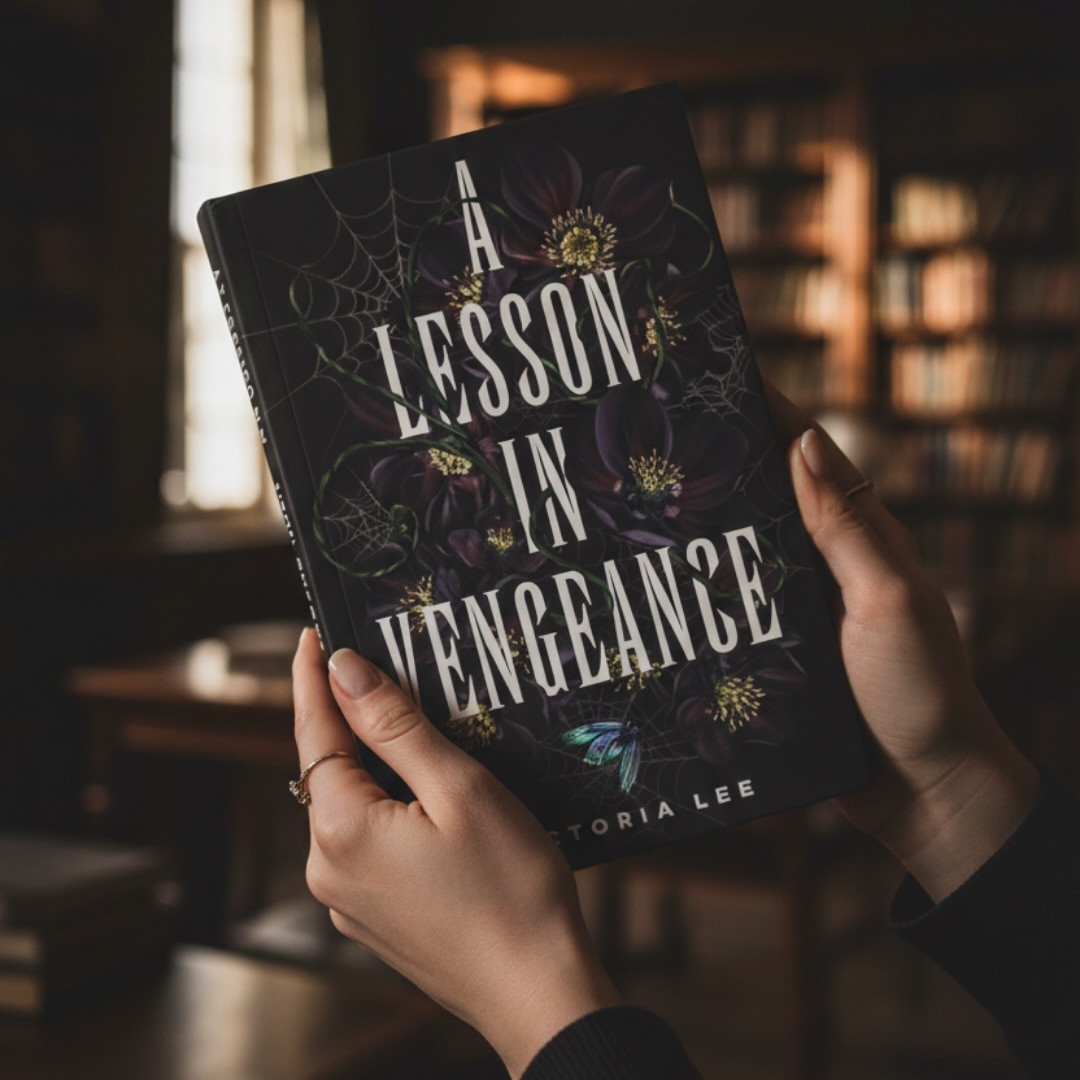
A Lesson in Vengeance
-------------------------------------
Author: Victoria Lee
Published: 2021
Genre: YoungAdult(YA)
-------------------------------------
IBC Editorial Rating: 4.5/5
This book is handpicked by the IBC Editorial Team. If you are an author, publisher, or reader and would like to have a book reviewed by IBC, you may reach us at editorial@indianbookclub.com — we’ll be happy to review it.
-------------------------------------
Editorial Review:
Victoria Lee's A Lesson in Vengeance plunges readers into the shadowed halls of Dalloway School, a centuries-old institution where tragedy and occult history intertwine beneath ivy-covered walls. Felicity Morrow returns after a year's absence following her girlfriend's death, determined to graduate and leave the darkness behind. But at Dalloway, the past refuses to stay buried. When Ellis Haley, a prodigious seventeen-year-old novelist, arrives seeking to research the mysterious deaths of the Dalloway Five—students rumored to be witches who died on school grounds—Felicity finds herself pulled back into the arcane world she swore to abandon. As Ellis's obsessive research intensifies and strange events begin echoing historical patterns, Felicity must confront whether the supernatural forces at Dalloway are real or manifestations of her own unraveling mind. Lee crafts atmospheric dark academia that interrogates truth, grief, and the fine line between genius and madness.
-------------------------------------
Book Summary:
The novel opens with Felicity Morrow's return to Dalloway School in the Catskill mountains, a prestigious institution whose Gothic architecture and centuries of tradition conceal a troubling occult legacy. A year has passed since her girlfriend Alex's death, and Felicity hopes that completing her senior year will provide closure. She returns to Godwin House, an exclusive dormitory with a sinister reputation: it stands on the grounds where the Dalloway Five—students who allegedly practiced witchcraft—died mysteriously across different eras, one after another. Dalloway's relationship with witchcraft is complex and contradictory. Officially, the school distances itself from such history, but students embrace it in whispered conversations and secret gatherings. Before Alex's death, Felicity herself was drawn to the occult, participating in rituals and exploring the supernatural with her girlfriend. Now, haunted by grief and struggling with mental health challenges, including anxiety and what she describes as psychotic depression, Felicity is determined to focus solely on her senior thesis and avoid anything connected to Dalloway's dark past. This resolution crumbles with the arrival of Ellis Haley, a brilliant and eccentric first-year student who has already published a successful novel at seventeen. Ellis practices "method writing," immersing herself completely in her subjects, and has chosen the Dalloway Five as the topic for her second book. Recognizing Felicity's knowledge of the occult and her connection to Godwin House, Ellis recruits her as a research assistant. Despite her intentions to stay away from the arcane, Felicity cannot resist the magnetic pull she feels toward Ellis—both intellectually fascinated by her brilliance and emotionally drawn to her intensity. As they delve into historical records, diaries, and campus legends, the research begins to consume both young women. Lee interweaves the stories of the five dead students—Leonie, Kajal, Clara, and others—revealing how each was misunderstood, marginalized, or punished for behaviors that challenged social norms. The novel draws parallels between the historical persecution of "witches" and the contemporary dismissal of women's mental health struggles, particularly how powerful or non-conforming women have been pathologized across centuries. Strange occurrences begin to plague Felicity: visions, missing time, and unexplained phenomena that mirror the experiences preceding each of the Dalloway Five's deaths. Lee employs the unreliable narrator technique masterfully, leaving readers uncertain whether these events reflect genuine supernatural forces, Felicity's deteriorating mental state, or manipulation by someone with darker intentions. The line between reality and delusion becomes increasingly blurred as Felicity's grip on her own narrative weakens. The relationship between Felicity and Ellis intensifies, fraught with intellectual passion, possible romance, and growing unease. Ellis's obsessive dedication to her book takes on troubling dimensions, and Felicity begins to question whether Ellis sees her as a collaborator, a subject, or something more sinister. The power dynamics shift constantly as both young women guard secrets and manipulate information to serve their own needs. Lee builds toward a climactic revelation that reframes everything readers have witnessed, delivering a twist that forces reassessment of character motivations, event sequences, and the very nature of truth within the narrative. The conclusion addresses questions of agency, complicity, and whether grief and trauma can ever be fully overcome or whether they fundamentally transform those who survive them.
-------------------------------------
Key Takeaways:
- "The Pathologization of Female Power and Non-Conformity": Lee draws explicit parallels between historical witch accusations and contemporary mental health dismissals, demonstrating how societies across eras have labeled threatening or misunderstood women as dangerous. The novel argues that "madness" and "witchcraft" often function as labels designed to discredit rather than understand women who refuse prescribed roles. - "Grief's Distortion of Reality and Identity": Felicity's struggle with Alex's death explores how profound loss can fundamentally alter perception, making it difficult to distinguish between external events and internal psychological responses. The narrative suggests that grief is not a process with clear stages but a destabilizing force that can reshape one's entire relationship with truth and selfhood. - "The Seductive Danger of Obsession": Both Ellis's method writing and Felicity's descent into research illustrate how intellectual passion can become consuming and destructive when it eclipses self-preservation. Lee examines the fine line between dedication and obsession, particularly in academic or creative contexts that reward all-consuming commitment. - "Unreliable Narration and the Construction of Truth": By making Felicity's perspective fundamentally unstable, Lee forces readers to actively question what constitutes reliable knowledge and how trauma affects storytelling. The novel suggests that all narratives are constructed rather than objectively transmitted, particularly when filtered through damaged psyches. - "Dark Academia's Romanticization of Suffering": Lee both employs and critiques dark academia aesthetics, acknowledging the genre's appeal while interrogating its tendency to glamorize self-destruction, unhealthy relationships, and institutional toxicity. The novel asks whether the pursuit of knowledge justifies the personal costs often demanded by elite educational environments. - "Queer Desire in Spaces of Historical Persecution": Felicity's relationships with both Alex and potentially Ellis exist within an institution historically hostile to non-conforming women, adding layers of meaning to her experiences. Lee explores how LGBTQ+ individuals navigate spaces haunted by the persecution of those who came before them.
-------------------------------------
Iconic Lines, Scenes & Characters:
- "Godwin House as Malevolent Space": The dormitory functions as more than a setting, becoming a character itself—a repository of dark history that seems to exert influence over its inhabitants. Lee's atmospheric descriptions capture how architecture can embody institutional memory and perpetuate cycles of trauma. - "Ellis Haley's Enigmatic Brilliance": The prodigy novelist embodies both aspiration and menace, her intelligence and charisma making it difficult to discern whether she represents salvation, danger, or something more complex. Her character demonstrates how genius can mask manipulation and how admiration can blind observers to darker motivations. - "The Dalloway Five as Historical Mirrors": Each of the dead students represents different facets of female persecution—intellectual ambition, sexual agency, emotional intensity—creating a composite portrait of how patriarchal systems eliminate threatening women. Their stories demonstrate that "witch" has always been shorthand for "woman we want to silence." - "Felicity's Unreliable Narration": Lee's technique of making readers question every event creates genuine uncertainty about what is real, what is imagined, and what is deliberately fabricated. This narrative strategy transforms reading into detective work, forcing active engagement with questions of truth and perception. - "The Twist Ending's Recontextualization": Without spoiling specifics, Lee delivers a conclusion that requires readers to reassess everything they've accepted as truth throughout the narrative. The revelation demonstrates how perspective shapes interpretation and how the same events can support radically different understandings depending on whose story receives priority. - "Mental Health Representation Without Romanticization": Lee depicts Felicity's psychological struggles with specificity and seriousness, avoiding the tendency to treat mental illness as either a shameful secret or an artistic enhancement. The portrayal acknowledges how conditions like psychotic depression genuinely distort reality while maintaining respect for Felicity's agency and intelligence.
-------------------------------------
Who Should Read This:
A Lesson in Vengeance will particularly appeal to readers drawn to dark academia aesthetics and psychological complexity. Those who enjoyed the atmospheric menace of Donna Tartt's The Secret History or the Gothic campus setting of Ninth House by Leigh Bardugo will find Lee's Dalloway School similarly compelling. The novel rewards readers who appreciate unreliable narrators and narratives that demand active interpretation rather than passive consumption, making it ideal for those who enjoy being kept off-balance by their reading material. Fans of queer young adult fiction that doesn't center coming-out narratives or identity discovery will appreciate Lee's approach to Felicity's sexuality as fact rather than journey. The novel assumes LGBTQ+ identity as a baseline rather than a plot point, focusing instead on how queer relationships function within toxic or oppressive environments. Readers interested in feminist reinterpretations of witch persecution and the historical continuum between witch trials and contemporary pathologization of women will find thematic richness throughout. Those who appreciate psychological horror grounded in ambiguity rather than explicit supernatural confirmation will find Lee's approach sophisticated and unsettling. The novel maintains uncertainty about whether events reflect genuine occult forces or psychological breakdown, refusing to provide definitive answers that would resolve the tension between rational and supernatural explanations. Readers who enjoyed the ambiguous horror of Shirley Jackson or the psychological unreliability of Gillian Flynn's work will recognize similar techniques employed here. However, prospective readers must approach this novel with awareness of its significant mental health content and triggering subject matter. Lee depicts psychotic depression, grief, possible hallucinations, gaslighting, and the aftermath of a partner's death with unflinching detail. The review appropriately notes that readers should consult trigger warnings before beginning, as the novel "goes to some dark places" that may be harmful for those struggling with similar issues. The atmospheric darkness that makes the book compelling for some readers may be genuinely distressing for others, particularly those dealing with mental health challenges or recent loss. Readers seeking straightforward plotting or clear moral distinctions may find the narrative's deliberate ambiguity frustrating rather than intriguing. The unreliable narrator technique means that certainty about events is rarely possible, and the twist ending, while effective, requires accepting that much of what seemed true was not. Those who prefer traditional mystery structures with definitive resolutions may find Lee's approach unsatisfying, though this is more a matter of personal preference than narrative weakness. The novel functions as young adult fiction but addresses mature themes with sophistication that will also engage adult readers comfortable with YA perspectives. The boarding school setting and teenage protagonists are balanced by complex psychological exploration and literary ambition that transcend typical YA limitations. Readers who dismiss young adult literature categorically may be surprised by the novel's depth, though those seeking exclusively adult perspectives might find the age of the protagonists limiting. A Lesson in Vengeance ultimately speaks most powerfully to readers who understand that the most effective horror often lies in uncertainty—not knowing whether to trust your own perceptions, whether the person you're drawn to has your best interests at heart, or whether the darkness surrounding you originates externally or within. Lee has crafted a novel that honors both Gothic tradition and contemporary psychological realism, creating a reading experience that is intellectually engaging, emotionally intense, and genuinely unsettling. For those willing to sit with ambiguity and darkness, this debut offers both the aesthetic pleasures of dark academia and substantive exploration of grief, power, and the stories we tell ourselves to survive.
************************
IBC Editorial Note:
This review is part of the Indian Book Club’s editorial initiative to spotlight books that inspire, inform, and leave a lasting impact on readers. Every title featured is carefully handpicked and reviewed by the IBC Editorial Team to maintain quality, authenticity, and literary value. If you are an author, publisher, or reader and would like to submit a book for review, we’d be delighted to hear from you. Please write to us at: editorial@indianbookclub.com Our team personally evaluates each submission, and selected books are featured as official IBC Editorial Reviews on our platform.